Controller Class Reference
Handles the menu/command system... when it detects the EmergencyStopMC is activated, it'll kick into high priority. More...
#include <Controller.h>
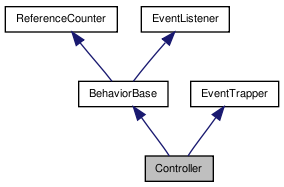
Detailed Description
Handles the menu/command system... when it detects the EmergencyStopMC is activated, it'll kick into high priority.
Keeps track of a command stack. A Control can designate another sub-control, which will receive events until it finishes
Events will then be sent to the parent again.
The GUI uses the same commands as the user (makes it much easier to have only one parser). The commands are:
- '
!refresh' - redisplays the current control (handy on first connecting, or when other output has scrolled it off the screen) - '
!reset' - return to the root control - '
!next' - calls ControlBase::doNextItem() of the current control - '
!prev' - calls ControlBase::doPrevItem() of the current control - '
!select[item]' - calls ControlBase::doSelect() of the current control, unless item is specified, in which case it is searched for, starting at the root. - '
!cancel' - calls current ControlBase::doCancel(), indicates control should cease activity and return to parent (e.g. "Back" button) - '
!dump_stack' - requests a dump of the current stack of submenus (useful if the GUI (re)connects and thus current robot state is unknown) - '
!postgenerator source type [duration]' - posts an event of your choosing; Generator should be an entry in EventBase::EventGeneratorNames (e.g. timerEGID) or numeric value; source should be a numeric value (unless generator is buttonEGID, in which case it could be an entry from buttonNames); type can be a numeric value, EventBase::EventTypeNames (e.g.activate), or EventBase::EventTypeAbbr (e.g.A); duration, if specified, gives the value for EventBase::duration - '
!msgtext' - sends text out as a TextMsgEvent; also note that any text entered on the console port while a GUI is also connected will also be sent as a TextMsgEvent, without needing the !input. - '
!roottext' - calls ControlBase::takeInput(text) on the root control - '
!hello' - responds with 'hello\ncount\n' where count is the number of times '!hello' has been sent. Good for detecting first connection after boot vs. a reconnect. - '
!hilight[n1 [n2 [...]]]' - hilights zero, one, or more items in the menu - '
!inputtext' - calls ControlBase::takeInput(text) on the currently hilighted control(s) - '
!setsection.key=value' - will be sent to Config::setValue(section,key,value) - '
!refreshsketchworld' - refresh world sketch - '
!refreshsketchlocal' - refresh local sketch - '
!refreshsketchcamera' - refresh camera sketch - any text not beginning with '
!' - sent to ControlBase::takeInput() of the current control
In return, to send the menus to the GUI, the following messages are sent: (newlines are required where shown)
- '
push' - signals a submenu has been activated - '
pop' - signals a submenu has been closed - '
refresh
text:title
int:numitems
bool:hasSubmenus1
bool:hilighted1
text:item-title1
text:item-description1
...
bool:hasSubmenusnumitems
bool:hilightednumitems
text:item-titlenumitems
text:item-descriptionnumitems' - refreshes the current menu
- '
status
text' - sets the status bar to text (until the next refresh) - '
load
text:classname
text:instancename
int:port
[arg1 [arg2 [...]]]' - tells the GUI to load the java class named classname, and have it connect to port, passing it the argument list. classname should contain a constructor of the formClassname(Stringhost,intport,Stringargs[])the argument list is parsed as if it were on the console - unescaped or unquoted spaces will separate args into elements in the array - '
close
text:instancename' - callsclose()on an object previously created by aloadmessage. The Java object is expected to contain a functionvoid close(). - '
stack_dump
int:depth
text:item-title1
...
text:item-titledepth' - a listing of the current stack, first item is root, last item is current control - '
goodbye' - Indicates the connection is about to be closed purposefully, to differentiate from an accidental cut off.
bool types are expected to be numerical values, 0 for false, non-zero for true.
load and close are intended to allow pop-up windows for custom displays.
The upstream is the responsibility of the individual Controls, but the protocol is listed here to keep it together. When a control's state changes, it's that control's responsiblity to refresh the UI (LEDs, console, and GUI as appropriate). Thus, future extensions to the upstream protocol are between the control which will use it and the GUI. Future extensions to the downstream protocol would involve changing Controller and the GUI.
The Controller may connect to serr in the future to pop-up an alert anytime output to serr occurs.
Note that all state is maintained on the robot - even if the GUI is connected, you can still use the buttons to interact with the controller, and the GUI will update to reflect the changes. In HCI (Human Computer Interaction) parlance, this is the MVC, Model-View-Controller architecture, almost by necessity. (HCI happens to be my double major when I was an undergrad ;)
Also, the Controller is responsible for sending out TextMsgEvents from user input it receives - either a !msg command from the console or GUI, or any text at all which is received on the console if there is already a GUI connected.
These TextMsgEvents are always status events, and the duration field is always 0.
Definition at line 105 of file Controller.h.
Public Member Functions | |
| Controller () | |
| Constructor. | |
| Controller (ControlBase *r) | |
| Constructor, sets a default root control. | |
| virtual | ~Controller () |
| Destructor. | |
| virtual void | doStart () |
| register for events and resets the cmdstack | |
| virtual void | doStop () |
| stop listening for events and resets the cmdstack | |
| virtual void | doEvent () |
| just for e-stop activation/deactivation | |
| virtual bool | trapEvent (const EventBase &e) |
| passes an event to the top control | |
| void | reset () |
| will take the command stack back down to the root | |
| void | refresh () |
| refreshes the display, for times like sub-control dying, the previous control needs to reset it's display | |
| void | refreshSketchWorld () |
| refresh world sketches | |
| void | refreshSketchLocal () |
| refresh local sketches | |
| void | refreshSketchCamera () |
| refresh camera sketches | |
| void | push (ControlBase *c) |
| puts a new control on top | |
| void | pop () |
| kills the top control, goes to previous | |
| ControlBase * | top () |
| returns the current control | |
| Controller & | setRoot (ControlBase *r) |
| sets the root level control | |
| Controller & | setEStopID (MotionManager::MC_ID estopid) |
| Sets the emergency stop MC to monitor for pausing. | |
| virtual std::string | getDescription () const |
| Gives a short description of what this particular instantiation does (in case a more specific description is needed on an individual basis). | |
Static Public Member Functions | |
| static std::string | getClassDescription () |
| Gives a short description of what this class of behaviors does... you should override this (but don't have to). | |
| static void | loadGUI (const std::string &type, const std::string &name, unsigned int port) |
| attempts to open a Java object on the desktop | |
| static void | loadGUI (const std::string &type, const std::string &name, unsigned int port, const std::vector< std::string > &args) |
| attempts to open a Java object on the desktop | |
| static void | closeGUI (const std::string &name) |
| calls close() on a Java object loaded with loadGUI() (on the desktop) | |
| static int | gui_comm_callback (char *buf, int bytes) |
| called by wireless when there's new data from the GUI | |
| static int | console_callback (char *buf, int bytes) |
| called by wireless when someone has entered new data on the tekkotsu console (NOT cin) | |
Static Public Attributes | |
| static Controller * | theOneController = NULL |
| currently can't pull connection socket off of server socket, so only one Controller | |
| static EventBase | nextItem |
| event masks used by processEvent() | |
| static EventBase | prevItem |
| event masks used by processEvent() | |
| static EventBase | nextItemFast |
| event masks used by processEvent() | |
| static EventBase | prevItemFast |
| event masks used by processEvent() | |
| static EventBase | selectItem |
| event masks used by processEvent() | |
| static EventBase | cancel |
| event masks used by processEvent() | |
Protected Member Functions | |
| void | init () |
| calls initButtons with the appropriate button offsets for the host robot model | |
| void | initButtons (unsigned fastTime, unsigned downTime, unsigned nextB, unsigned prevB, unsigned nextFastB, unsigned prevFastB, unsigned selectB, unsigned cancelB) |
| assigns appropriate values to the static event bases | |
| void | takeLine (const std::string &s) |
| called with each line that's entered on the tekkotsu console or from the GUI | |
| void | dumpStack () |
| sends stack of currently active controls | |
| bool | select (ControlBase *item, const std::string &name) |
| called with slots (options), a name to lookup; will select the named control | |
| int | setConfig (const std::string &str) |
| sets a config value - some values may require additional processing (done here) to have the new values take effect | |
| bool | setNext (ControlBase *next) |
| maintains top Control | |
| void | activate () |
| called when the estop switches on | |
| void | deactivate () |
| called when the estop switches off | |
| bool | chkCmdStack () |
| returns true if a valid control is available on the stack | |
Static Protected Member Functions | |
| static bool | calcPulse (unsigned int t, unsigned int last, unsigned int period) |
| returns true when the current time and last time are in different periods | |
Protected Attributes | |
| MotionManager::MC_ID | display |
| invalid_MC_ID if not active, otherwise id of high priority LEDs | |
| MotionManager::MC_ID | estop_id |
| the EmergencyStopMC MC_ID that this Controller is monitoring | |
| ControlBase * | root |
| the base control, if cmdstack underflows, it will be reset to this | |
| std::stack< ControlBase * > | cmdstack |
| the stack of the current control hierarchy should never contain NULL entries | |
| unsigned int | last_time |
| the time of the last event | |
| unsigned int | cur_time |
| the time of the current event (do*() can check this instead of calling get_time() ) | |
| float | nextEv_val |
| the magnitude of the last next event (nextItem) | |
| unsigned int | nextEv_dur |
| the duration of the last next event (nextItem) | |
| float | prevEv_val |
| the magnitude of the last prev event (prevItem) | |
| unsigned int | prevEv_dur |
| the duration of the last prev event (prevItem) | |
| bool | alreadyGotBoth |
| if doReadStdIn() was already called, but the buttons are both still down | |
| bool | isControlling |
| true if the Controller is currently active (in the activate()/deactivate() sense, not doStart()/doStop() sense - use isActive() for that...) | |
| bool | usesButtons |
| true if ControllerGUI knows how to use the buttons for menu navigation, will intercept button presses | |
| Socket * | gui_comm |
| the socket to listen on for the gui | |
Private Member Functions | |
| Controller (const Controller &) | |
| shouldn't be called... | |
| Controller & | operator= (const Controller &) |
| shouldn't be called... | |
Constructor & Destructor Documentation
| Controller::Controller | ( | ) |
Constructor.
Definition at line 107 of file Controller.h.
| Controller::Controller | ( | ControlBase * | r | ) |
Constructor, sets a default root control.
Definition at line 108 of file Controller.h.
| virtual Controller::~Controller | ( | ) | [virtual] |
Destructor.
Definition at line 109 of file Controller.h.
| Controller::Controller | ( | const Controller & | ) | [private] |
shouldn't be called...
Member Function Documentation
| void Controller::activate | ( | ) | [protected] |
called when the estop switches on
causes the top control to activate, registers for button events
Definition at line 583 of file Controller.cc.
Referenced by doEvent(), and setEStopID().
| static bool Controller::calcPulse | ( | unsigned int | t, | |
| unsigned int | last, | |||
| unsigned int | period | |||
| ) | [static, protected] |
returns true when the current time and last time are in different periods
Definition at line 204 of file Controller.h.
Referenced by trapEvent().
| bool Controller::chkCmdStack | ( | ) | [protected] |
returns true if a valid control is available on the stack
if the stack is empty, will push root if it's non-null
Definition at line 608 of file Controller.cc.
Referenced by activate(), push(), refresh(), takeLine(), and trapEvent().
| void Controller::closeGUI | ( | const std::string & | name | ) | [static] |
calls close() on a Java object loaded with loadGUI() (on the desktop)
Definition at line 230 of file Controller.cc.
Referenced by SegCam::closeServer(), RegionCam::closeServer(), RawCam::closeServer(), DepthCam::closeServer(), WorldStateSerializerBehavior::doStop(), HeadController::doStop(), ArmController::doStop(), and Aibo3DControllerBehavior::doStop().
| int Controller::console_callback | ( | char * | buf, | |
| int | bytes | |||
| ) | [static] |
called by wireless when someone has entered new data on the tekkotsu console (NOT cin)
Definition at line 269 of file Controller.cc.
| void Controller::deactivate | ( | ) | [protected] |
called when the estop switches off
causes the top control to deactivate, stops listening for buttons
Definition at line 596 of file Controller.cc.
Referenced by doEvent(), and setEStopID().
| void Controller::doEvent | ( | ) | [virtual] |
just for e-stop activation/deactivation
Reimplemented from BehaviorBase.
Definition at line 85 of file Controller.cc.
| void Controller::doStart | ( | ) | [virtual] |
register for events and resets the cmdstack
Reimplemented from BehaviorBase.
Definition at line 40 of file Controller.cc.
| void Controller::doStop | ( | ) | [virtual] |
stop listening for events and resets the cmdstack
Reimplemented from BehaviorBase.
Definition at line 63 of file Controller.cc.
| void Controller::dumpStack | ( | ) | [protected] |
sends stack of currently active controls
Definition at line 539 of file Controller.cc.
Referenced by takeLine().
| static std::string Controller::getClassDescription | ( | ) | [static] |
Gives a short description of what this class of behaviors does... you should override this (but don't have to).
If you do override this, also consider overriding getDescription() to return it
Reimplemented from BehaviorBase.
Definition at line 143 of file Controller.h.
Referenced by getDescription().
| virtual std::string Controller::getDescription | ( | ) | const [virtual] |
Gives a short description of what this particular instantiation does (in case a more specific description is needed on an individual basis).
By default simply returns getName(), because any calls from a BehaviorBase function to getClassDescription() are going to call BehaviorBase::getClassDescription(), not ~YourSubClass~getClassDescription(), because static functions can't be virtual in C++ (doh!)
This means that getDescription called on a pointer to a BehaviorBase of unknown subtype would always return an empty string, which is pretty useless. So instead we return the name in this situation. If you want getDescription to return getClassDescription, you'll have to override it in your subclass to do so.
Reimplemented from BehaviorBase.
Definition at line 144 of file Controller.h.
| int Controller::gui_comm_callback | ( | char * | buf, | |
| int | bytes | |||
| ) | [static] |
called by wireless when there's new data from the GUI
Definition at line 238 of file Controller.cc.
Referenced by doStart().
| void Controller::init | ( | ) | [protected] |
calls initButtons with the appropriate button offsets for the host robot model
Select which model is running and call initButtons with the appropriate button offsets This could be somewhat simplified by using capabilities.getButtonOffset(), (wouldn't need the ERS2xx case with essentially duplicated ERS210 and ERS220 cases), but this style has the advantage that the symbols are checked by the compiler so there's no chance of a typo in a button name going unnoticed.
Definition at line 316 of file Controller.cc.
Referenced by Controller().
| void Controller::initButtons | ( | unsigned | fastTime, | |
| unsigned | downTime, | |||
| unsigned | nextB, | |||
| unsigned | prevB, | |||
| unsigned | nextFastB, | |||
| unsigned | prevFastB, | |||
| unsigned | selectB, | |||
| unsigned | cancelB | |||
| ) | [protected] |
assigns appropriate values to the static event bases
Definition at line 357 of file Controller.cc.
Referenced by init().
| void Controller::loadGUI | ( | const std::string & | type, | |
| const std::string & | name, | |||
| unsigned int | port, | |||
| const std::vector< std::string > & | args | |||
| ) | [static] |
attempts to open a Java object on the desktop
Definition at line 212 of file Controller.cc.
| static void Controller::loadGUI | ( | const std::string & | type, | |
| const std::string & | name, | |||
| unsigned int | port | |||
| ) | [static] |
attempts to open a Java object on the desktop
Definition at line 147 of file Controller.h.
Referenced by WorldStateSerializerBehavior::doStart(), HeadController::doStart(), ArmController::doStart(), Aibo3DControllerBehavior::doStart(), WalkCalibration::err(), loadGUI(), SegCam::setupServer(), RegionCam::setupServer(), RawCam::setupServer(), and DepthCam::setupServer().
| Controller& Controller::operator= | ( | const Controller & | ) | [private] |
shouldn't be called...
| void Controller::pop | ( | ) |
kills the top control, goes to previous
Definition at line 186 of file Controller.cc.
| void Controller::push | ( | ControlBase * | c | ) |
puts a new control on top
Definition at line 177 of file Controller.cc.
Referenced by chkCmdStack(), and setNext().
| void Controller::refresh | ( | ) |
refreshes the display, for times like sub-control dying, the previous control needs to reset it's display
Definition at line 159 of file Controller.cc.
Referenced by pop(), reset(), setRoot(), and takeLine().
| void Controller::refreshSketchCamera | ( | ) |
refresh camera sketches
Definition at line 173 of file Controller.cc.
| void Controller::refreshSketchLocal | ( | ) |
refresh local sketches
Definition at line 169 of file Controller.cc.
| void Controller::refreshSketchWorld | ( | ) |
refresh world sketches
Definition at line 165 of file Controller.cc.
| void Controller::reset | ( | ) |
will take the command stack back down to the root
Definition at line 149 of file Controller.cc.
Referenced by doStart(), doStop(), setRoot(), and takeLine().
| bool Controller::select | ( | ControlBase * | item, | |
| const std::string & | name | |||
| ) | [protected] |
called with slots (options), a name to lookup; will select the named control
Definition at line 368 of file Controller.cc.
Referenced by takeLine().
| int Controller::setConfig | ( | const std::string & | str | ) | [protected] |
sets a config value - some values may require additional processing (done here) to have the new values take effect
Definition at line 554 of file Controller.cc.
Referenced by takeLine().
| Controller & Controller::setEStopID | ( | MotionManager::MC_ID | estopid | ) |
Sets the emergency stop MC to monitor for pausing.
Definition at line 200 of file Controller.cc.
| bool Controller::setNext | ( | ControlBase * | next | ) | [protected] |
maintains top Control
- Parameters:
-
next one of: - NULL: pop() cmdstack
- cmdstack.top(): nothing
- other address: push(next)
- Returns:
- true, all the time, for convenience from trapEvent()
Definition at line 575 of file Controller.cc.
Referenced by push(), select(), takeLine(), and trapEvent().
| Controller & Controller::setRoot | ( | ControlBase * | r | ) |
sets the root level control
Definition at line 193 of file Controller.cc.
| void Controller::takeLine | ( | const std::string & | s | ) | [protected] |
called with each line that's entered on the tekkotsu console or from the GUI
Definition at line 390 of file Controller.cc.
Referenced by console_callback(), and gui_comm_callback().
| ControlBase* Controller::top | ( | ) |
returns the current control
Definition at line 137 of file Controller.h.
| bool Controller::trapEvent | ( | const EventBase & | e | ) | [virtual] |
passes an event to the top control
Implements EventTrapper.
Definition at line 95 of file Controller.cc.
Member Data Documentation
bool Controller::alreadyGotBoth [protected] |
if doReadStdIn() was already called, but the buttons are both still down
Definition at line 219 of file Controller.h.
Referenced by trapEvent().
EventBase Controller::cancel [static] |
event masks used by processEvent()
Definition at line 121 of file Controller.h.
Referenced by initButtons(), and trapEvent().
std::stack< ControlBase* > Controller::cmdstack [protected] |
the stack of the current control hierarchy
should never contain NULL entries
Definition at line 201 of file Controller.h.
Referenced by activate(), chkCmdStack(), deactivate(), dumpStack(), pop(), push(), refresh(), reset(), setNext(), takeLine(), top(), and trapEvent().
unsigned int Controller::cur_time [protected] |
the time of the current event (do*() can check this instead of calling get_time() )
Definition at line 214 of file Controller.h.
Referenced by trapEvent().
MotionManager::MC_ID Controller::display [protected] |
invalid_MC_ID if not active, otherwise id of high priority LEDs
Definition at line 191 of file Controller.h.
Referenced by activate(), chkCmdStack(), deactivate(), doStart(), doStop(), and push().
MotionManager::MC_ID Controller::estop_id [protected] |
the EmergencyStopMC MC_ID that this Controller is monitoring
Definition at line 194 of file Controller.h.
Referenced by setEStopID().
Socket* Controller::gui_comm [protected] |
the socket to listen on for the gui
Definition at line 223 of file Controller.h.
Referenced by activate(), chkCmdStack(), closeGUI(), console_callback(), doStart(), doStop(), dumpStack(), loadGUI(), pop(), push(), refreshSketchCamera(), refreshSketchLocal(), refreshSketchWorld(), and takeLine().
bool Controller::isControlling [protected] |
true if the Controller is currently active (in the activate()/deactivate() sense, not doStart()/doStop() sense - use isActive() for that...)
Definition at line 220 of file Controller.h.
Referenced by activate(), deactivate(), doEvent(), doStart(), setEStopID(), and takeLine().
unsigned int Controller::last_time [protected] |
unsigned int Controller::nextEv_dur [protected] |
the duration of the last next event (nextItem)
Definition at line 216 of file Controller.h.
Referenced by trapEvent().
float Controller::nextEv_val [protected] |
the magnitude of the last next event (nextItem)
Definition at line 215 of file Controller.h.
Referenced by trapEvent().
EventBase Controller::nextItem [static] |
event masks used by processEvent()
Definition at line 116 of file Controller.h.
Referenced by initButtons(), ValueEditControl< T >::pause(), ValueEditControl< T >::processEvent(), and trapEvent().
EventBase Controller::nextItemFast [static] |
event masks used by processEvent()
Definition at line 118 of file Controller.h.
Referenced by initButtons(), and trapEvent().
unsigned int Controller::prevEv_dur [protected] |
the duration of the last prev event (prevItem)
Definition at line 218 of file Controller.h.
Referenced by trapEvent().
float Controller::prevEv_val [protected] |
the magnitude of the last prev event (prevItem)
Definition at line 217 of file Controller.h.
Referenced by trapEvent().
EventBase Controller::prevItem [static] |
event masks used by processEvent()
Definition at line 117 of file Controller.h.
Referenced by initButtons(), ValueEditControl< T >::pause(), ValueEditControl< T >::processEvent(), and trapEvent().
EventBase Controller::prevItemFast [static] |
event masks used by processEvent()
Definition at line 119 of file Controller.h.
Referenced by initButtons(), and trapEvent().
ControlBase* Controller::root [protected] |
the base control, if cmdstack underflows, it will be reset to this
Definition at line 197 of file Controller.h.
Referenced by chkCmdStack(), setRoot(), takeLine(), and ~Controller().
EventBase Controller::selectItem [static] |
event masks used by processEvent()
Definition at line 120 of file Controller.h.
Referenced by initButtons(), and trapEvent().
Controller * Controller::theOneController = NULL [static] |
currently can't pull connection socket off of server socket, so only one Controller
Definition at line 225 of file Controller.h.
Referenced by closeGUI(), console_callback(), doStart(), doStop(), dumpStack(), gui_comm_callback(), loadGUI(), pop(), push(), refreshSketchCamera(), refreshSketchLocal(), refreshSketchWorld(), takeLine(), and ~Controller().
bool Controller::usesButtons [protected] |
true if ControllerGUI knows how to use the buttons for menu navigation, will intercept button presses
Definition at line 221 of file Controller.h.
Referenced by activate(), init(), initButtons(), and takeLine().
The documentation for this class was generated from the following files:
